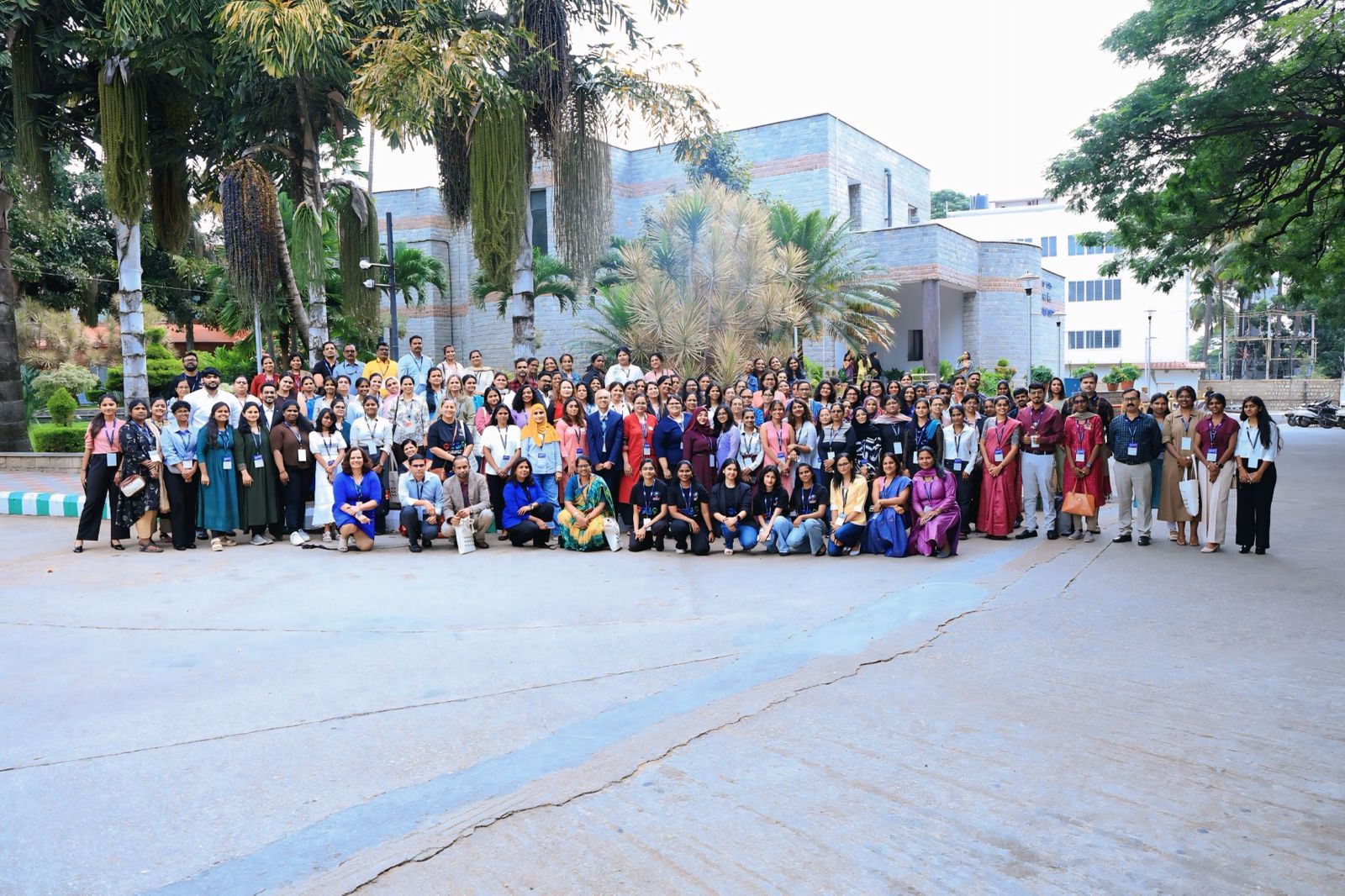
Ethan AI presents clinical validation results at NIMHANS Autism Synergies 2026.
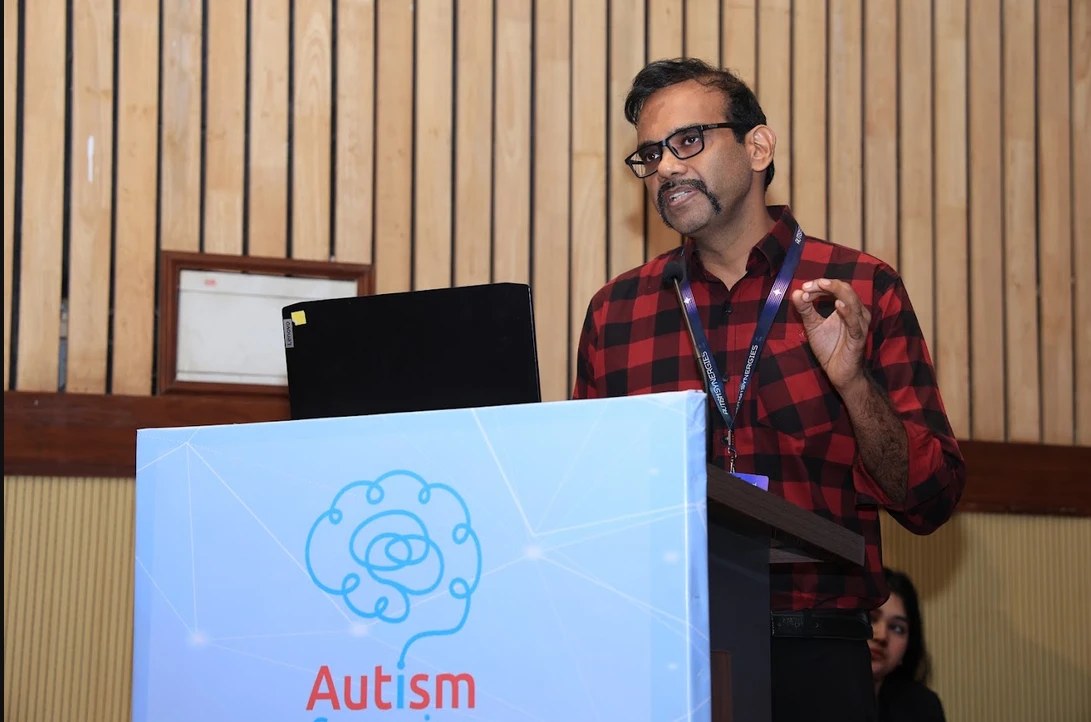
On 26 July 2026, Ethan AI presented clinical validation results in an oral presentation at Autism Synergies 2026, hosted at the National Institute of Mental Health and Neurosciences (NIMHANS), Bengaluru.
The presentation was delivered by Pratush Charan, Head of Product at Ethan AI, an engineer and the parent of a non verbal autistic son, after whom the system is named. It covered an eight week study of Ethan AI’s camera based behaviour recognition platform, co authored with Shilpa Pakki, and conducted with 34 non verbal autistic children aged 5 to 17, across homes and therapy centres, with ground truth provided by certified special educators and ethics review through a partner centre.
The talk opened with the clinical case for continuous observation. One in a hundred children in India are on the autism spectrum (INCLEN, PLoS Med 2018). Self injurious behaviour has a pooled prevalence of 42% in autism (Steenfeldt-Kristensen meta analysis, 2020, n=14,379). Nearly half of autistic children, 49%, attempt to wander or elope after the age of four (Anderson et al., Pediatrics 2012). None of these behaviours follow a clinic schedule.
Existing tools do not close the gap. Paper ABC diaries show 90% reported compliance against 11% actual compliance. Parent recall misses 58% of observed behaviour. Digital therapy platforms rely on manual entry, which still requires a human to catch the event first. Research systems that do detect automatically remain confined to laboratories, wearables, or offline video.
A case described in the presentation illustrated the cost of that gap. A boy was sedated for aggression; the underlying cause was an abscess in his mouth. He had been touching his cheek for days. The signal was present, but no trained observer was in the room at the moment it mattered.
Ethan AI runs on cameras already present in care environments: RTSP CCTV, IP cameras, standard webcams. It requires no wearable on the child and no GPU on site. The architecture composes pretrained perception models rather than training on autism specific data: MediaPipe Pose for keypoints, YAMNet for audio events, SigLIP for image and text gating, and a vision language model on an asynchronous channel for summarisation. No child data is used to train models. A three tier runtime separates continuous low cost processing from sampled and asynchronous reasoning, making continuous operation viable at Indian price points. Each behaviour is specified as a composable recipe over those signals rather than as a separately trained model.
The headline results were measured as event level agreement against expert human observation, across six behaviour classes.
Study at a glance: 8 weeks · 34 non verbal and minimally verbal children, ages 5 to 17 · homes and partner therapy centres · ground truth from certified special educators · centre level clinical review · 0 biometric or facial recognition data captured.
Four behaviours run in production today: head banging, distress vocalisation, head posture, and glasses on and off. A fifth, safe zone exit, is in extended pilot. Six were benchmarked in the feasibility study.
The presentation was equally direct about what does not work yet. Hand flapping sits below the sensitivity floor of pose estimation at typical camera distances; fusing a wearable signal with the camera is the plausible fix, and has not been built. Fall detection remains unreliable in cluttered rooms and under partial occlusion. Rocking is sensitive to camera angle, hair pulling is confounded with ordinary self touch, and climbing furniture requires spatial reasoning that has not been implemented. These were given a slide of their own: recipes ship only when they meet their stated accuracy targets.
The study’s own constraints were stated alongside the results. There was no control group, and ground truth came from a single rater. It establishes feasibility, not efficacy, and is not presented as a clinical trial.
On comparison with prior work, the presentation did not claim the highest reported accuracy. Wearable studies report higher figures, but from laboratory settings, six subject datasets, hospital wards, or devices the child must agree to wear. Ethan AI’s figures come from ordinary cameras operating continuously in homes and therapy centres, currently across 2 pilot sites, 10+ cameras and 50+ persons. This is a setting the existing literature does not cover.
Dr. Vijaya Raman, Professor of Clinical Psychology at St. John’s National Academy of Health Sciences, concluded her own presentation with a line that framed much of the day:
Every behaviour has a story, and every story deserves to be heard.
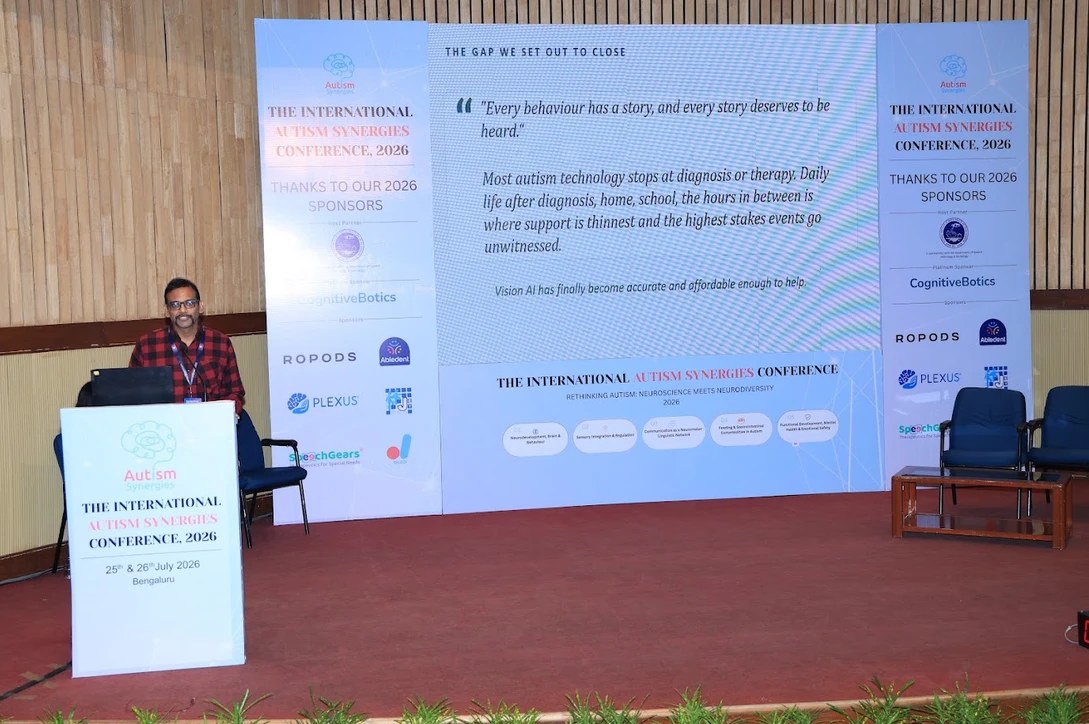
The same sentence had opened Ethan AI’s second slide: behaviour is communication, and for a child who does not speak it may be the only available channel. Continuous observation is how that record accumulates between clinic appointments.
The most substantive feedback came from the floor. A parent asked whether the system could detect the ingestion of harmful substances, a request that describes pica, a well documented and dangerous behaviour associated with autism. It has entered the roadmap. Under the recipe architecture, adding a behaviour is a specification problem rather than a data collection and retraining problem. Fast, small, hand to mouth events nonetheless remain among the harder recognition challenges, and recipes ship only when they work.
Ethan AI is now actively inviting clinical researchers to co design the next phase of validation studies: inter rater reliability, ecological validity, and longitudinal stability. These are the three questions this study was not designed to answer. Enquiries can be sent to hello@ethanai.in.
Ethan AI thanks the conference organisers and Ms. Chitra Thadathil, Founder of Autism Synergies and convenor of the conference, for the platform, and the families and partner centres whose participation made the study possible.
Co design the next study with us
We are looking for clinical partners on inter observer agreement, accuracy over time, and caregiver burden impact in Indian care settings.
Ethan AI is a caregiver support aid, not a diagnostic instrument. Clinical judgement stays with clinicians. The study described here establishes feasibility, not efficacy.